Separate Database Isolation from Data Privacy
Guepard Team
November 13, 2026
A team creates a separate database for a development branch and calls it isolated. The branch cannot overwrite production, so the change is considered safe. But the copy still contains customer addresses, and every developer has owner access. Workload isolation succeeded. Privacy did not.
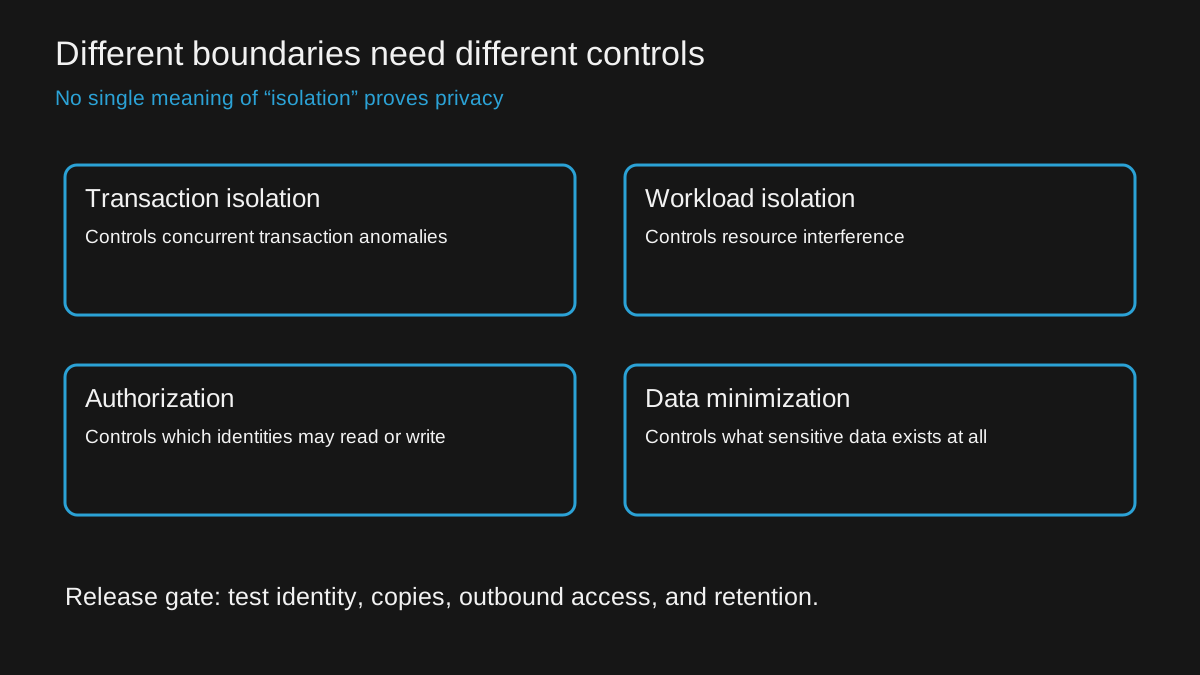
The word isolation hides several independent questions. Can concurrent transactions produce an invalid result? Can one workload exhaust another's resources? Can a developer read data they should not see? Can a copied environment contact production services? Answering one does not answer the others.
Name the boundary you need
Transaction isolation controls interactions among concurrent transactions. PostgreSQL's serializable level targets results equivalent to some serial execution of committed transactions; applications must handle serialization failures. It does not decide whether a role should be allowed to read customer records. PostgreSQL transaction isolation
Workload isolation separates resource consumption or failure domains. Separate compute can reduce interference without changing the underlying data's sensitivity. Access isolation restricts identities and operations. Network isolation limits reachable systems. Data minimization reduces what exists in the environment in the first place.
Write each requirement independently. For a preview environment, a useful specification might say: no production writes; no production credentials; no unrestricted outbound access; no direct identifiers in developer-visible tables; synthetic external-service integrations; and automatic expiry with a verified deletion process. Each requirement needs its own control and test.
Trace copies, not just queries
List the routes by which data reaches the environment: backup restoration, snapshots, exports, CDC, application fixtures, and logs. A carefully masked table is insufficient if its original values remain in an adjacent export file or an error log. Include temporary storage, query results, object storage, and build artifacts in the inventory.
Prefer synthetic data when the task is about application behavior rather than exact production distributions. Where representative data is required, document the minimal columns and rows needed. Perform transformation before granting developer access. Giving access first and running a masking job later creates an exposure window even if the final table looks safe.
Pseudonymization is not an automatic claim of anonymity. Stable replacements preserve joins but can also preserve linkability across datasets. Removing names does not eliminate identification risk from rare combinations of location, dates, and events. Review the intended recipient and use case rather than treating one transformation as universal proof of privacy.
Treat row policies as a tested authorization layer
For a shared multi-tenant service, row-level security can add a useful enforcement layer. PostgreSQL supports policies governing which rows a role can read or modify. However, superusers and roles with BYPASSRLS bypass these policies, and table owners normally do too unless configured otherwise. Test with the actual application role, not an administrative session. PostgreSQL row security policies
A conceptual test matrix is more useful than a policy copied without its identity model:
Role: application runtime, tenant A
Read tenant A row: allowed
Read tenant B row: denied
Insert tenant B row: denied
Change tenant A row to tenant B: denied
Missing tenant context: denied
Reused pooled connection after tenant B: still tenant A only
If tenant context is stored in a session setting, establish who can set it and whether a caller can spoof it. Reset context safely across connection-pool reuse; transaction-local settings can help limit leakage but do not authenticate the tenant by themselves. Also test privileged functions and maintenance paths. An application query filter is not a replacement for understanding these bypass routes.
Build an environment release gate
Before making a copy available, verify its data classification, transformation version, role grants, outbound destinations, and retention deadline. Run negative tests that attempt forbidden reads and writes using ordinary developer and service identities. Record the result in the environment's creation workflow.
Scan for recognizable synthetic canaries placed in restricted source fields. Their presence in a destination where those fields should be removed reveals a failed transformation path. Use synthetic markers rather than exposing real sensitive values in test reports. Combine these checks with structural inspection because a canary cannot cover every possible leakage pattern.
At expiry, remove the live environment and account for retained backups, exports, caches, and logs according to the applicable policy. Deleting the database endpoint alone does not demonstrate that all copies disappeared. Limit access during the retention period and record what remains and why.
Keep the claims narrow and verifiable
Describe controls precisely: “separate compute,” “production writes blocked,” or “customer contact fields removed before access.” Avoid the umbrella claim “fully isolated” unless every relevant boundary has been defined and tested.
Privacy emerges from minimizing data, controlling identities, limiting propagation, and managing lifecycle. Transaction and workload isolation remain valuable, but they solve different problems. A safer database environment makes those distinctions visible before anyone is invited to connect.
Guepard Team
Guepard Engineering

