Rehearse a MySQL Restore Before You Trust the Backup
Guepard Team
November 14, 2026
A successful backup command proves that a backup process ran. It does not prove that the resulting files can restore the service, that required encryption keys are available, or that transactions after the backup can be recovered. A restore rehearsal closes that evidence gap.
Use an isolated recovery target with no outbound application side effects. The goal is to verify a recoverable business state, not merely start mysqld.
The concrete problem
For a small all-InnoDB MySQL 8.4 application, a logical dump can be a useful rehearsal input. This example is illustrative and omits credentials deliberately. Mixed storage engines, concurrent DDL, large datasets and managed-service restrictions require a different or extended method.
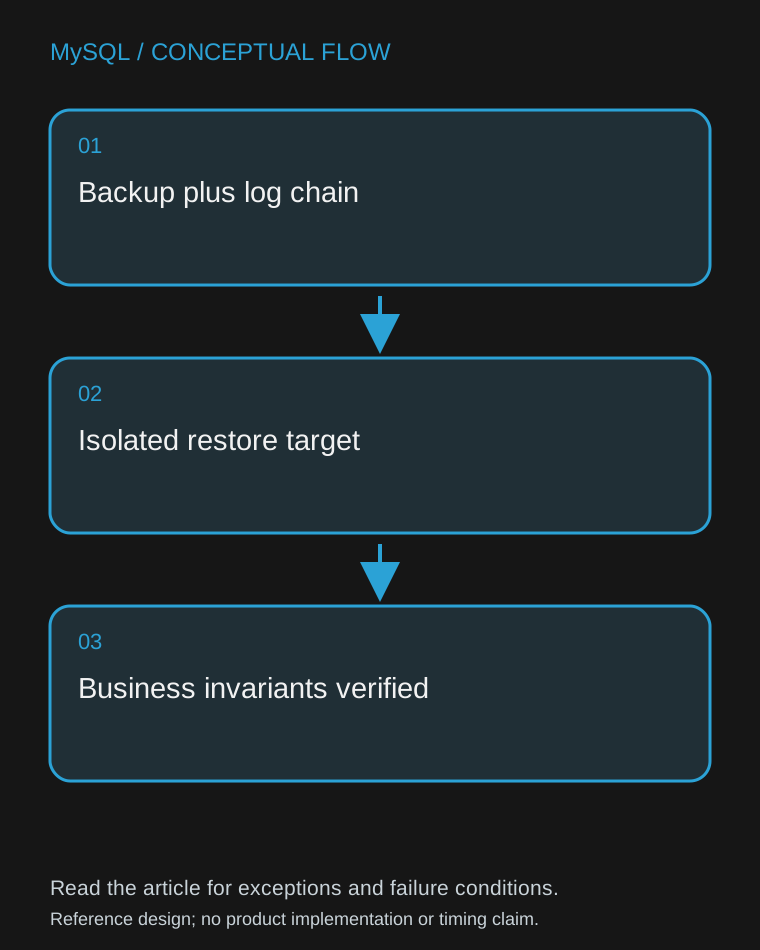
Figure: Backup plus log chain → Isolated restore target → Business invariants verified.
A worked example
# Example commands: use approved authentication outside shell history.
mysqldump --single-transaction --routines --events --triggers   --databases app > app-backup.sql
# Restore only into the designated isolated rehearsal server.
mysql --host=restore-host < app-backup.sql
# Example application consistency check:
mysql --host=restore-host app -e "
SELECT COUNT(*) AS orphan_lines
FROM order_lines l LEFT JOIN orders o ON o.id=l.order_id
WHERE o.id IS NULL;"
Why the behavior matters
--single-transaction gives transactional consistency for relevant transactional tables, not a universal freeze of every object and storage engine. Coordinate DDL during the dump window. Include routines, events and trigger requirements explicitly, then prevent restored scheduled jobs from triggering real actions.
A point-in-time recovery plan needs binary-log continuity and a trustworthy relationship between the base backup and log positions or GTID state. Those details depend on the chosen backup method. Do not infer a safe recovery starting point from the dump file modification time.
Failure modes and design tradeoffs
Database users, grants, plugins, configuration, certificates and external dependencies may live outside the application dump. Restoring tables into an incompatible version or different collation environment can create errors or behavior changes. Encryption also adds a key-recovery dependency that should be exercised without exposing secrets in logs.
A checksum match is useful but not a replacement for business checks. A database can be structurally intact while missing the most recent paid order or containing a partially reconciled external workflow.
What to verify before adoption
Record backup start/end, restore start, database availability, invariant validation and application readiness. Confirm orphan checks, aggregate reconciliation and a small read/write smoke test. If replaying binary logs, stop at a selected transaction boundary and prove an intentionally later marker is absent. Save the runbook and measured results separately from this unexecuted example.
Primary reference
- MySQL documentation. Verify the exact deployed version and driver behavior before using the example in a production runbook.
Guepard Team
Guepard Engineering

