MongoDB Transactions Start With a Data-Model Decision
Guepard Team
November 14, 2026
MongoDB provides atomicity for a single document. Multi-document transactions extend the boundary, but they add coordination cost and failure-handling obligations. Before wrapping every workflow in a transaction, ask whether the data that must change together belongs in one document.
Embedding is not always better: unbounded arrays, independent access patterns and document growth can make references appropriate. The goal is a clear invariant and a deliberate transaction boundary.
The concrete problem
A transfer between two independently stored quota records needs both updates to succeed or neither. The pseudocode uses a supported MongoDB driver transaction helper and a replica-set or sharded deployment that supports the operation. A standalone server is not a substitute for that test topology.
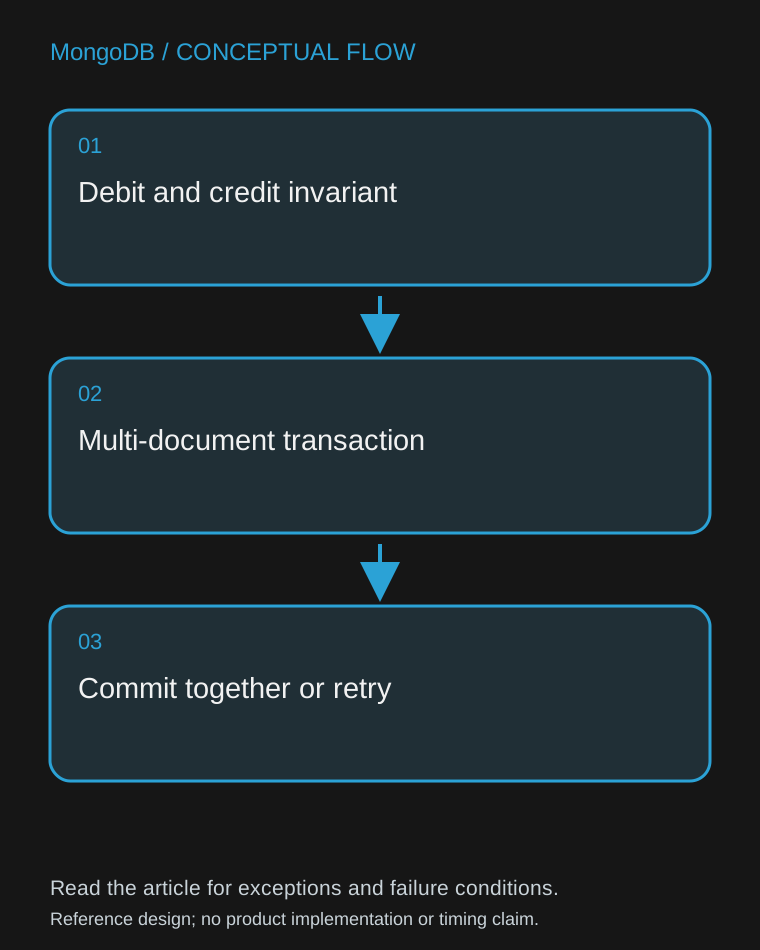
Figure: Debit and credit invariant → Multi-document transaction → Commit together or retry.
A worked example
# Illustrative Python driver pattern; configure client securely.
def transfer(session):
    result = quotas.update_one(
        {'_id': 'a', 'remaining': {'$gte': 3}},
        {'$inc': {'remaining': -3}}, session=session)
    if result.modified_count != 1:
        raise ValueError('Insufficient quota')
    credit = quotas.update_one(
        {'_id': 'b'}, {'$inc': {'remaining': 3}}, session=session)
    if credit.matched_count != 1:
        raise ValueError('Destination quota does not exist')

with client.start_session() as session:
    session.with_transaction(transfer)
Why the behavior matters
The debit condition belongs in the update predicate, so the database evaluates sufficient quota at the write boundary. The transaction groups the debit and credit. Production code must check both outcomes, select appropriate concerns and account for retries documented by the exact driver.
A callback may execute more than once during retry handling. Do not send an email, charge a card or publish an irreversible event directly inside a retryable callback. Use a durable intent/outbox pattern or another explicitly idempotent external protocol.
Failure modes and design tradeoffs
Transactions are not an excuse to hold locks and resources while waiting on an HTTP request. Keep them short and bounded. Large operations, topology changes and conflicts can cause failures that need application handling rather than indefinite retries.
Choosing majority write concern or a snapshot read concern is a semantic decision, not a performance incantation. Verify the resulting visibility and durability requirements for the actual deployment. Avoid assuming that a generic helper's defaults match every application contract.
What to verify before adoption
Inject a failure between the two updates and prove that the net transfer does not partially commit. Test missing destination, insufficient balance and a transient conflict. Count callback executions to expose retry behavior, and verify no external side effect repeats. Document why two documents are needed instead of presenting a transaction as the default model.
Primary reference
- MongoDB documentation. Verify the exact deployed version and driver behavior before using the example in a production runbook.
Guepard Team
Guepard Engineering

