Keep Time Zones Explicit in Analytical Pipelines
Guepard Team
13 novembre 2026
Version scope: DuckDB 2.0. The SQL in this article was run on DuckDB 2.0.0 against small synthetic fixtures.
An event can belong to one UTC date and a different business date. That is not a database bug. It is a consequence of asking different questions about the same instant. Reliable reporting keeps those questions separate.
An instant identifies when something happened on a global timeline. A local date assigns that instant to a calendar used by a business. A formatted string is a display choice. Collapsing all three into an ambiguous timestamp field makes later corrections expensive.
DuckDB documents timestamp-with-time-zone operations, including conversion with AT TIME ZONE; named-zone behavior depends on time-zone support such as the ICU extension. A time-zone-aware value does not by itself preserve the original place name from an input string. DuckDB timestamp-with-time-zone functions
Specify the reporting calendar
Suppose a report groups events by the civil date in America/New_York. Store the instant and the reporting-zone identifier as explicit parts of the analysis contract. Do not use the analyst laptop's local setting as an implicit business rule.
This example illustrates a conversion. Validate it on your own pinned engine and extension versions.
SET TimeZone = 'UTC';
WITH events(event_id, occurred_at) AS (
  VALUES
    (1, TIMESTAMPTZ '2026-10-01 00:30:00+00'),
    (2, TIMESTAMPTZ '2026-10-01 12:30:00+00')
)
SELECT
  event_id,
  occurred_at,
  CAST(occurred_at AT TIME ZONE 'America/New_York' AS DATE)
    AS business_date
FROM events
ORDER BY event_id;
The expected local dates differ: event 1 belongs to September 30 in New York, while event 2 belongs to October 1. Those expectations should become assertions in the executable lab, not merely labels in a screenshot.
Design boundary tests around the calendar
Include an event immediately before and immediately after local midnight. Include the dates when daylight-saving rules change in the relevant jurisdiction. A local civil day need not contain exactly twenty-four hours, so a calendar-day report should not be defined as “the previous 86,400 seconds” unless that is truly the product requirement.
An input with local wall time and no zone may be ambiguous during a repeated hour. During a clock jump, some local times may not exist. Decide how the producer resolves those cases. Retaining the original offset, zone and source timestamp can help explain an interpretation, but the exact fields needed depend on the producer's guarantees.
For date-range queries, define the start and end instants corresponding to the required local boundaries, then use a half-open interval: start inclusive, end exclusive. This avoids double-counting a boundary event across adjacent runs. Test the conversion rather than deriving offsets by hand.
Keep policy changes reviewable
If a customer changes its reporting zone, decide whether historical reports keep the old calendar or are recomputed. Either answer can be legitimate; silently changing historical buckets is not. Version the reporting policy alongside the query and input snapshot.
Time-zone databases can change as governments revise rules. A reproducible analysis bundle should record the runtime and time-zone support used. For long-lived regulatory or financial reporting, review the exact historical interpretation requirements with the responsible specialists rather than assuming a generic SQL conversion is sufficient.
The engineering principle is to preserve the instant, name the calendar and test the boundary. Once those choices are explicit, disagreements about a daily total become diagnosable instead of mysterious.
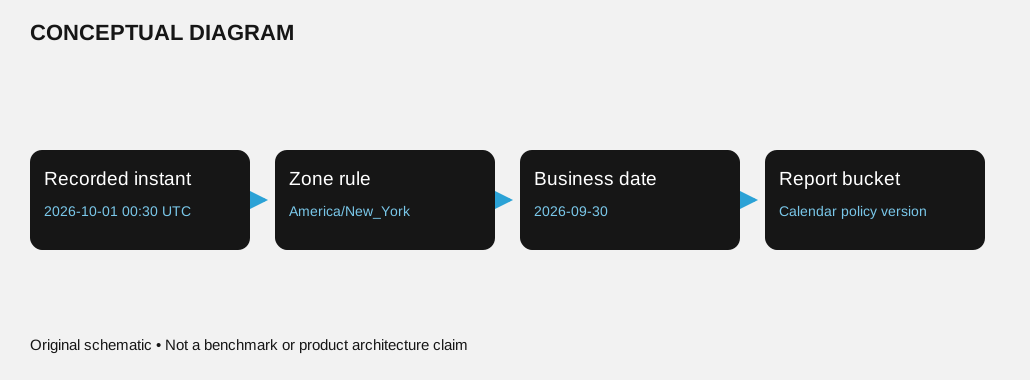
One instant maps to a business date under an explicit zone rule. Display format is not the calendar policy.
Guepard Team
Guepard Engineering

